Overview...The Bad Attitude
from Hawk
Mountain Enterprises (HM) is a standard kit.
However, I ordered the 75mm motor mount tube (MMT) option.
Since the rocket
is to be used as my Tripoli Level 3
certification project, I need to be able to
load an M-motor which are most typically found
in 75mm or 94mm sizes. I also ordered an additional
94mm 54" booster section (stock, as used on
Hermes 3 is 42") that I will
use with a HM aluminum fin can in a
minimum-diameter variant for
Hermes 4.
The Bad Attitude is an all-fiberglass (FG)
airframe.
The parts are fabricated very well with minimum
tolerances and nice finish - Alan Gorecki has
done a very nice job with the kit. Each part was
checked/fitted at HM before it was shipped,
assuring there would be no issues upon arrival.

I plan to use most of the dual-deployment
(DD) features that I worked out during the design and
construction of Hermes 2.
The Bad Attitude comes with an electronics-bay mid-coupler
section for the flight computers, as well as an
e-bay in the nosecone for recovery trackers.
Unlike Hermes 2, the
intent is for this rocket to achieve fairly
high altitudes (my initial RockSim simulation
suggests it will do 15K'+ with an M650 motor),
so the Big
Red Bee TX RF tracker and the Big Red Bee 70cm (ham
band) GPS systems will probably come into play.
Construction:
Before I started any construction, I designed a
totally new
RockSim file (see above) since I could not
find one out on the Web. I wanted to be sure
that the goals I set out for performance after a
discussion with Alan prior to purchase seemed
reasonable. Additionally, I wanted to be able to do
the Center of Pressure
(CP) and Center of Gravity (CG) calculations, as
well as flight simulations, for my Level 3
certification.
The all FG kit is straight-forward and
contains a 4-1 Ogive style nosecone (with
e-bay), an upper airframe, a 1.5" mid
section/coupler for the ejection systems and a
48" slotted booster section. The fins are
upgraded to the 0.187" variety and attach
through-the-airframe to the 30" 75mm MMT.
Booster Section
Motor Mount Tube - The booster/MMT
section
utilizes a Kevlar strapping system for safety retention.
Safety is the key mark in any rocket design,
particularly for high flying, relatively heavy
rockets such as the Bad Attitude. This Kevlar strap is provided in the
kit already knotted and furnished with a large
ball-bearing swivel - all components in the kit
are first-rate and designed to tolerate large
mach speeds and gee forces - no compromises at any level in
this kit.
The kit includes three MMT-to-booster centering rings (CR).
The forward CR is a 1/2" birch plywood piece
that is slotted on the 75mm I.D. on both sides to accommodate
the strap. I passed the ends of the strap
through either side of the CR, and then folded
each end and epoxied them to opposing sides of the MMT below the CR
which I had previously epoxied to the front end
of the MMT.

I mounted the forward CR and
strap to the MMT with
Loctite Hysol E-20HP
epoxy. This epoxy is an industrial grade epoxy
with a shear of over 4500 PSI and is applied
with a gun system that dispenses the 2:1 ratio
ingredients perfectly through a mixing nozzle,
eliminating the tedious task of measuring and
mixing. I used this epoxy throughout the
construction except for tacking the fins in
place and creating the exterior fin
fillets (see the fin section below).

For motor retention/safety, I am using a
75mm
Aero Pack Quick-Change motor retainer. I
had to pre-install (dry) the retainer in order to
determine the exact location of the MMT within
the booster airframe such
that the CR's and the fins would align correctly
with the slots of the booster section.
After
marking the proper locations on the MMT and the
booster, and taking care to sand all the FG
surfaces on the booster and the MMT that would
be subject to epoxy, I applied a coat of epoxy
to the inside of the airframe for the forward CR
with a small brush taped to the end of a long
wooden dowel.
I then tucked the Kevlar safety strap into the MMT to
prevent getting any epoxy on it
and installed the MMT by sliding it in through
the rear of the booster. This allowed me to minimize the
internal epoxy
smear and create a small fillet on the forward
part of the CR. I placed the aft CR on
temporarily to keep the rear of the MMT centered
in the booster while the forward ring's epoxy
dried.

With the forward CR now firmly fixed, I made a special applicator extension for
applying the epoxy for the middle CR out of a
12" piece of 0.25" aluminum tube - I crimped one
end of the tube and drilled a series of small
holes in one side and
then taped the other end to one of a plastic mixing
nozzles. By sliding the aluminum tube between
the MMT and the booster, I was able to apply
epoxy to the inside of the airframe and outside
of the MMT, just ahead of the fin slots with a minimum of epoxy and mess.

After applying the epoxy, I pushed the middle
CR up the rear of the MMT with a couple of small
diameter dowels until it reached the marks I had
made earlier for its final position. Again, the
epoxy smear was minimized while still creating a
good, uniform bond for the CR to the MMT and the
airframe. Once that
set, I was ready to attach the fins.
Fins - Copying the basic idea for a
fin jig from
Vern
Knowles terrific web site, I set out to make
one of my own. I added a couple of things that
made the jig a little easier to true up the
booster and the fins. By using a couple of
stair-squares from a local hardware store, along
with some fabricated straps and band clamps, I
enhanced Vern's basic design slightly.
The squares keep
the booster perfectly plumb relative to the
jig's base. So, along with some carefully
constructed L-shaped angles
made from pine and composition board, clamping
the fins into position for proper alignment and attachment became
a relatively simple task.
Once the fins were tacked to the MMT and the
back of the middle CR with the E-120HP epoxy, I
was ready to apply strengthening fillets to the
interior portions of the fins.
I
taped off the resulting fin-slot gap on the outside to keep
any epoxy from running through to the face of
the booster (the E-20HP is relatively
thick/viscous and not much of a problem in this aspect).
I taped off the rear of the MMT to keep it clean
and created a rear dam for the epoxy with some
pieces of closed-cell foam which sort of wrapped
up slightly forward of the rear of the fin so I
did not have to worry about being able to
attached the rear centering ring up against the
rear of the fin later on (once the fillet epoxy
was almost set, I removed the foam pieces).
I made another tool for getting the epoxy up
between the MMT and the airframe, this time
using some tygon tubing taped to the end of the
epoxy mixing nozzle. Before pushing any epoxy
out the end of the tubing/mixer nozzle, I ran
the tubing up against the middle CR.

I then laid a line of epoxy as I drew the tubing
out. The tubing size was such that drawing the
tubing down between the MMT and the airframe
created a nice fillet to both sides. After the epoxy set, I epoxied the rear
CR in place.
The exterior fin fillets were then applied
using
Aeropoxy,
mixed with some West
System 406 Filler to give it a more thixotropic
consistency - I used a heaping teaspoon of
filler per ounce of mixed epoxy. I also found
that I needed to let the mixture of epoxy and
filler sit for just a few minutes after mixing
for it to reach its final working consistency
(the "mayonnaise" state, as suggested on the 406
box). I basically followed
Vern Knowles' method using a short section
of PVC pipe to smooth and shape the fillets.
I
used tongue depressors to initially apply the
epoxy to the fin joint which gave me a nice
applicator and also started the shaping process,
then used the pipe piece to form the final
fillet.

...dried
fillet...

...sanded
fillets/fins...
Once the mess of the filleting was over, I attached
the fixed piece of the two-piece
motor retainer to the MMT with
JB Weld,
a high-temp, strong two-part epoxy, along with
the rail launch-buttons included in the kit,
which were contoured to the airframe by sanding
and then secured to the fore and aft CRs with #8
screws and some epoxy.
Upper Airframe and Nosecone
There is
little to be done to these pieces save for
securing the e-bay to the nosecone and the finishing, and later, application of some shear
pins and plastic rivets (see below). The
nosecone is pre-fabricated by HM and includes a
retention strap.
It will house both of the
Big Red Bee
trackers in its e-bay. I cut a friction-fit sled
from a long piece of basswood and attached the
RF and GPS trackers with a tie-wrap.
The nosecone seams required a bit of work to
scrap/sand down in order to get a smooth finish
prep for painting. In retrospect, after getting
things smooth by scraping, I realized I should
have probably filled/sanded the seam gaps rather than
shave it in order to achieve the most rounded
final form.
Mid-section Coupler/Avionics-bay
Since I
had already built a fully redundant
dual-deployment (DD) CO2-based recovery system
electronics bay, I really only needed to "port"
the devices and concepts over to the HM FG
e-bay. Rather than use the smallish sled provided in the
kit, I fabricated a larger 3.5" x 9.25" sled from
some .125" G10 plate. Getting all that gear into
the 4" x 8" e-bay of
Hermes 2 was a challenge, so I wanted a bit
more room this time out. In addition to the room
afforded on the larger sled, I also will be
mounting the on-off switches for the flight
computers and the e-match shunts to the mid-section airframe, rather
than the sled itself which will free up some room.

...planning the layout...
...nearly finished...

I am using a
G-Wiz HCX as the primary
flight computer/ and a
Ozark ARTS2 as the secondary.
In the event that one of the manufacturers may
have a software bug, having to totally different
computers should alleviate any related issue and
allow deployment from at least one of them. In
keeping the two systems totally
redundant/isolated, I am incorporating a
pair of C&K P2011U2WM03NQ2 (similar to the
switch included in the HM kit, but the DPDT
version) ON-OFF
key-switches from
Newark
Electronics to
connect each of the CPU and pyro batteries to
each computer individually. As with the
Hermes 2 design, I
used a pair of audio-jacks (also from
Mouser) wired to provide 4-point shunts for the
Rouse-Tech CD3 CO2 ejection systems e-matches.
...the other
side...

I used
a
12-gram CO2 system for
smaller cavity of the booster section with the
drogue chute and a 16 gram system for the upper
airframe section housing the main chute.
Finish
I first went over all surfaces to be painted
with a wet-sanding of 320 grit. I initially
sprayed on a coat of
RustOleum Plastic Primer, then sanded/primered again
as needed.
After the initial primering, for the exterior
fin fillets, I filled in the air bubbles and
such with Bondo filler, sanded and then primered
again.
I
then applied three coats of gloss
white, wet sanding in between with 320 grit as
required. I finished it off with some various
widths of blue and black striping tape (Hermes 1
and Hermes 2 were of a red-white-and blue theme,
but since the upper section of Hermes 3 will be
used with Hermes 4, I needed to change the
scheme a bit since Hermes 4 will be using a
black anodized fin can). I added a few some custom decals, and
then a final coat of protective clear gloss.

Flight and Recovery:
I plan to test fly the new rocket prior to going
for the Level 3 certification flight. I normally
prefer to fly long, slow-burning motors, but
since the Bad Attitude is fairly
over-stable in design, I want to be sure the
early initial velocity is sufficient to get it
flying before it leaves the rail. So, I will use
a K1499N for the test flight.
If all goes well there, will assemble an
M1550R for the cert flight.
Once at the launch site, I will use my prepared
Hermes 3 Checklist during preparation and
pre-launch. The Checklist can be downloaded
here:
Hermes 3 Pre-flight Checklist
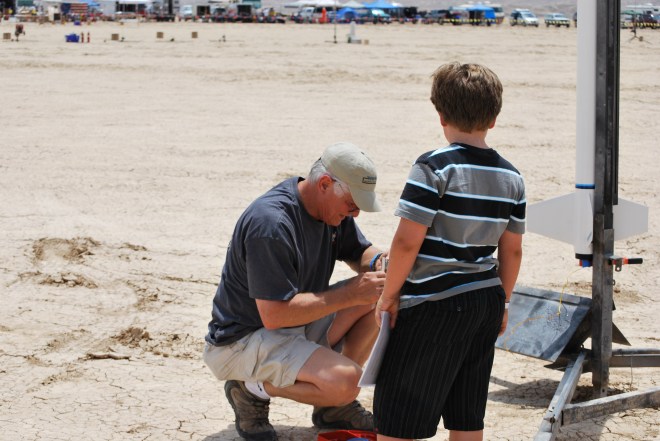
Summary:My Level 3 certification
flight was flown in June of 2009 at the ROCStock
launch at Lucerne Valley. Perfect up, perfect
down - recovered fully intact about 1/4 mile
from the pad after attaining 13K'+... ahhh ...an
L3!

Level 3 Certification Flight - June, 2009
Lucerne Valley, CA